Showing posts with label doilies. Show all posts

17 December 2006

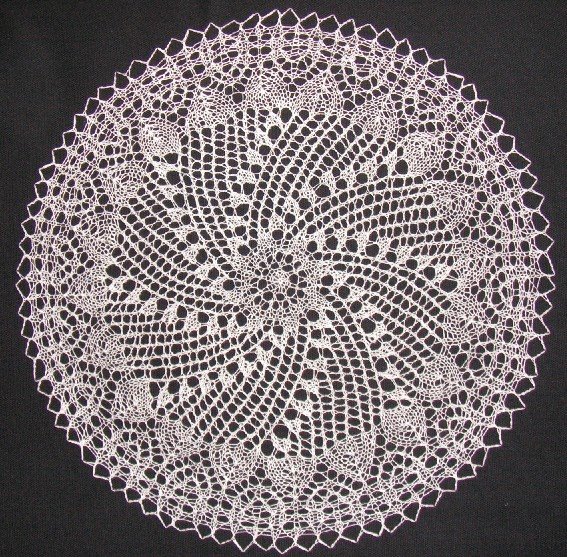
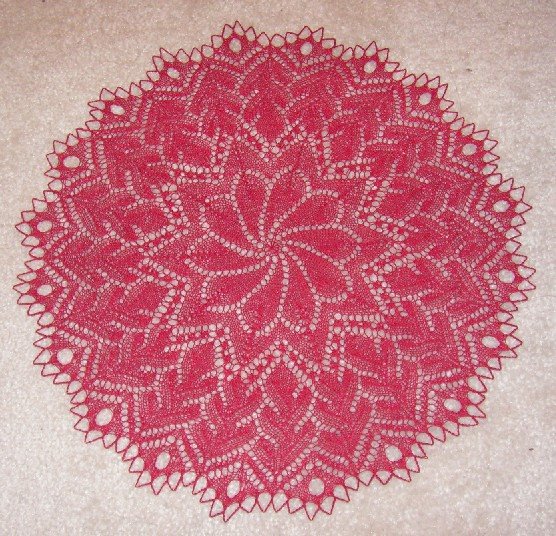
Knitting with sewing thread


Pattern: "L" from Erich Engeln leaflet #1
Thread: DMC Tatting (6-cord cotton thread, size 80)
Needles: 1.5 mm


Pattern: #47 from Burda special 198
Thread: Coats and Clark #40 cotton sewing thread
Needles: 1.5 mm

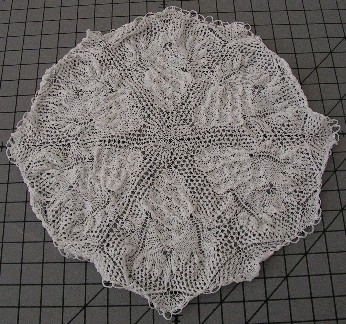
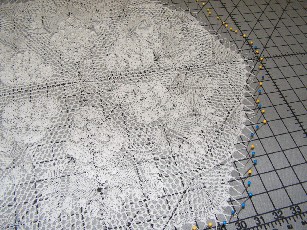
I knit the fuschia doily with the DMC Tatting 80 first and then cast on and knit the white doily immediately after freeing my needles from the fushchia doily. The doilies were each about 50 rounds with fairly basic stitchmaking and were completed very quickly. I just wanted to see what knitting with finer thread would be like. These two doilies are the finest threads I've used so far now, and of course I'm still experimenting.

I know people joke that all knitted doilies must have been made with "wires and sewing thread," but I have also heard people remark, without joking, that crochet cotton in about size 50 is actually equivalent to "sewing thread" weight thread. That is not true. Even the usual threads from sewing kits are a lot finer than the typically used crochet cottons, even "size 50" crochet cotton. This picture shows the Engeln 7F doily in DMC Cordonnet 60 on the right and the Burda 198-47 doily in Coats and Clark #40 sewing thread on the left in the same shot for comparison.


So, those of you who are afraid to start knitting with crochet cotton--take heart! It really isn't like something you would put into a sewing machine.

Yet, I had to ask myself, what is knitting with actual sewing thread like? Well, it's surprisingly doable, especially when you have 1.5 mm circular needles! Not long ago, I used 1.5 mm (US 000) needles for the first time with DMC Cordonnet 60, and I realized that 1.5 mm needles would be small enough for threads at least a little finer than size 60 crochet cotton. As it turns out, I now think I could still use 1.5 mm needles with thread slightly finer than the #40 sewing thread.

Looking at spools of sewing thread, now I can see the confusion regarding "size 50" thread. The sewing thread is in fact labeled by sizes—#40, #50, #60—just like crochet cotton thread. But the size numbers clearly do not mean the same things in sewing thread and in crochet cotton. Having just knit with the #40 Coats and Clark thread, I can say it is definitely finer than the DMC Tatting size 80 thread, and it feels just a little finer than DMC Cordonnet 100.

I really want to compare sewing threads to crochet cotton threads by their respective yards per pound numbers, but I don't have enough information. Balls of crochet cotton are marked with yardage and weight, but spools of sewing thread only list yardages. The sewing thread size numbers might be related to the cotton count system (more info on that here, here, and here) but I'm not 100% sure that sewing thread marked "3-ply, #40" means it is actually "40/3 thread" under the cotton count system. So, maybe I'll just have to get a McMorran yarn balance soon to work out the numbers once and for all.

1.5 mm circular needles: Inox vs. Addi

After knitting Engeln 7F with grey Inox 1.5 mm circulars, I did purchase a pair of Addi Turbo 1.5 mm circulars. I still don't think the Inox ones (which cost only about half of the Addis) are bad, but yes, the join on Addis is much better. I think how much the join matters depends on several things, including your tension, but overall, I'm sure that the smoothness of the join becomes more important as the thread gets finer relative to the needle size. Also, it is always harder to scoot lace knitting across the join (when you have a bunch of yarn overs mixed with knit stitches on the needle) than all knit stitches in plain knitting. So, working lace knitting with the DMC Tatting 80 and #40 sewing thread, I think the smooth join of the Addi needles was essential and worth the extra $$$.

Sewing thread: Coats and Clark vs. other brands

In addition to the Coats and Clark #40 sewing thread, I plan to knit a few other basic sewing threads recommended for sewing and machine quilting, all 100% cotton. (I am not a quilter, but from what I understand, threads labelled as "hand-quilting thread" usually have a coating that makes hand sewing easier, so I deliberately avoided buying hand-quilting thread for knitting.)


The Coats and Clark #40 sewing thread I used to knit Burda 198/42 is very soft and somewhat fuzzy. I probably would not knit with this thread again, at least not any larger, more time-consuming pieces.

However, I've already begun knitting another small doily with Gütermann #50 machine quilting thread, and it feels sharp, crisp, and not at all fuzzy. So far, I'm very impressed! I'd say it's actually a lot like high quality crochet cotton, only finer, and the Gütermann thread is much higher in quality, from a knitting perspective at least, than the Coats and Clark thread.


There are also threads that are much finer than "regular" sewing thread, like cotton threads from sizes 80/2 to 170/2 listed in the catalogs of Lacis and other lacemaking suppliers. Although I would like to find out what is the finest thread that is knittable, I'm putting off buying any of these truly freakish materials for next time, after I explore knitting with some other regular sewing threads I currently have on hand.

In any case, I don't know how many pieces I would knit with these ultra-fine threads. I want to attempt a few just for the challenge and novelty of it, but as I've already seen with the Coats and Clark thread, not all threads make good, durable pieces. For me, that also means not all threads are worth investing the time and effort to knit into lace. I am more interested in finding and knitting the finest thread available that still has some resemblance to high quality crochet cotton in terms of durability and appearance.

11 December 2006

"Erbstüllgrund" doily by Herbert Niebling

That ball of Flora thread I photographed in my last post? It's now a doily.


Pattern: Burda Special 903/42, "Erbstüllgrund" by Herbert Niebling
Thread: Flora cotton thread, size 50 (available from Lacis or Handy Hands)
Needles: 2 mm

This doily was 94 rounds total, and I used very close to one ball of Flora 50 (300 yards per ball). I blocked it using four short blocking wires threaded through almost every crochet loop along the four sides and just a few pins at the corner loops. The final measurement is 14 inches square.

This pattern also appears in an older Burda lace knitting special called "Kunststricken Folge 1" but as a 76-round pattern without the final border.

I was specifically looking for a doily that was small and square, and this is one of the few I found that included a real Niebling-type floral motif. Most of the other small square doily patterns I have seen are more geometrical, like "English Crystal" from Marianne Kinzel's first book. In any case, I discovered that patterns for round/octagonal/hexagonal doilies greatly outnumber square ones, at least in the smaller sizes.

As always, I loved knitting the unusual Niebling-type floral motifs. I especially like the use of two different lace background patterns to frame the center flowers. I worked the hexagonal mesh in this doily using knit 1, purl 1 into the double yarn over (instead of k1-k1tbl into the double yo, which I have done in the past to make the mesh tighter), and I like its airy openness in contrast to the small holes of the other lace pattern.


When I decided to knit a dark purple doily, I finally had a great excuse to check out some other brands of thread, since DMC Cebelia's color palette is pretty limited. Flora comes in many colors and is available in sizes 10, 20, and 50.

In certain ways, Flora in size 50 is a nice compromise between DMC Cordonnet and DMC Cebelia. DMC Cordonnet only comes in white and ecru in sizes 10-80 and 100 and DMC Cebelia comes in a variety of colors but only in sizes 10-30.

Flora 50, on the other hand, is a thread finer than size 30 that comes in a nice variety of colors, and even the hardness of Flora falls somewhere between razor-sharp Cordonnet and slightly softer Cebelia.

A definite disadvantage of Flora is that knots in the balls of thread are apparently more common. I encountered two knots in the ball I used to knit Erbstüllgrund. Another ball I purchased also has at least one knot, because I can actually see a few thread ends poking out from somewhere in the middle of the ball. I wouldn't be surprised if there are more knots I can't see yet. By comparison, I have yet to encounter knots in any ball of Cordonnet or Cebelia I have ever used. I'm not saying that none exist in any Cordonnet or Cebelia ball, but in my experience, they seem to be less common.

Relative abundance of knots is not a total deal-breaker for me, but it did stop me from stocking up on more Flora 50 for now. Plus, I'm still working on knitting finer and finer threads and finding my limitations. I won't know exactly what my favorite thread sizes and brands are until I knit many more pieces in different threads.

I haven't decided on what to cast on next, although I am fairly sure that the next thread will be either DMC Tatting (size 80) or DMC Cordonnet 100. I like having a small doily in progress all the time, but it seems like once I cast one on, I can't put it down until it's finished! I still have the large linen piece in progress, and I'm also working on the Melon Pattern Stole bit by bit during the commute.

21 November 2006

Duchrow 73/6

Don't ask me why, but "knitted lace" is a term usually reserved for patterns with lace patterning in every row or round, while "lace knitting" can refer to lace patterns with plain rows/rounds in between the pattern rows/rounds.

You can sometimes tell the two apart by looking at the yarn overs in a piece. In a typical "lace knitting" pattern, the yarn overs are followed by a plain round of knit stitches, so there are holes defined by two threads twisted together (one thread is the yarn over, the other thread is the knit stitch above it).

"Lace knitting":

However, in a "knitted lace" pattern, the yarn overs aren't always followed by knit stitches, so the holes are defined by single threads.

"Knitted lace":


This particular knitted lace pattern is a traditional Shetland lace pattern called "Bird's Eye" or "Spider Lace." It's in more than one stitch pattern book, I'm sure; if you've got Heirloom Knitting by Sharon Miller, see page 132. Sharon Miller notes that it doesn't really look like it's a knitted pattern. I've always been fascinated by it for that reason, but I hadn't had an excuse to knit it up until a tiny picture in one of the Christine Duchrow books caught my eye. Two days later, I completed this doily:


Pattern: Pattern 6 from Christine Duchrow leaflet #73 (reprinted in The Knitted Lace Patterns of Christine Duchrow, Volume III by Lacis)
Thread: Cordonnet 40 crochet cotton
Needles: 2 mm

Part of the fun for me in knitting this doily was bringing to life a piece from a weird old photo that may have been overlooked for decades. It's also the first piece I've made following an original Christine Duchrow leaflet.

The other part of the fun of course was the pleasure of seeing the bird's eye pattern unfold. It's a small stitch repeat and not difficult to work in the round despite yarn overs in every round. This stitch pattern in a piece worked back and forth is probably a bit trickier to make. (I've since noticed that the other Christine Duchrow pattern I've knitted, Egeblad, also features a stitch pattern in its outer rounds that is considered a traditional Shetland lace pattern: print o' the wave.)

This doily isn't the most ingeniously designed I've seen. The center eight-pointed star pattern simply ends with several plain rounds, then the bird's eye pattern starts after that without a connection to the center pattern. In fact, bird's eye is not even repeated by a multiple of eight times around the doily—it's repeated 28 times around. At first, just going by the number of stitches to work in the chart, I thought there might be an error in the pattern, but it was simply a matter of realizing that the bird's eye repeats weren't going to line up neatly over the repeats of the center star.

As it turned out, this particular pattern did not have any true errors as far as I could tell but there were definitely some quirks and potential pitfalls which I've been trying to document in some notes. Stay tuned for "German Knitting Patterns, part 3: Christine Duchrow," which I hope will be coming soon to the blog!


Yeah, I intend to reblock this doily at some point. It has an excessive number of crochet loops (meaning: many, many pins crowded together!) so I just focused on pulling and opening up the lace during the first blocking without worrying about making perfectly neat crochet loops. Next time, I'll just moisten it slightly, and I'll be able to pin it out again more evenly since I won't have to pull hard on the piece then.

19 November 2006

Erich Engeln 7F


Pattern: "F" from Erich Engeln leaflet #7
Thread: Cordonnet 60 crochet cotton
Needles: 1.5 mm

This doily is my first one using thread and needles this fine. I chose this design because not knowing how well I'd do with size 60 thread, I didn't want to get too tripped up by the stitch-making (it mostly uses only yos and the usual left, right, and double decreases). It was also designed with three possible stopping rounds, so if I decided I couldn't stand knitting it, I could have bailed out early with a tiny doily featuring only the center star. I ended up knitting the full pattern.

With my other projects on 2 mm needles, I usually have no problems at all starting with a circular cast-on on 6-inch bamboo dpns, which are light and easy for me to manuever. However, the 1.5 mm needles I have are 8-inch metal double points and two 24-inch circulars (Inox "greys"). Starting this doily on the long, heavy dpns was tricky. During the earliest rounds, none of the needles would stay in place in the stitches by themselves, so I had to hold onto all of them. Every time I switched dpns, I had to put the entire work down and carefully pick it up again in the new orientation. Eventually there were enough stitches on the needles to keep things together, but then I just put the work on two circs because the needles still felt heavy and awkward. I would probably just cast on directly onto the two circs next time—I only grabbed the dpns first this time because I hadn't anticipated the problems.

To my knowledge, there are only two companies that produce 1.5 mm circular needles: Inox and Addi. I don't have the Addi version to compare, but I can say that the Inox ones are pretty good. I don't love the cables of regular-sized grey Inox needles, but in the 1.5 mm needles, the plastic cable is extra thin and quite flexible.

Once I was knitting the project with the circular needles, it really didn't feel much different from knitting with my usual Cebelia 30 thread. The Cebelia 30 felt, surprisingly, a little bit "fat" when I switched back and forth between knitting this doily and the final rounds of Weintrauben, but otherwise my ability to make and see the stitches was pretty much the same.

Of course, this piece is smaller than others I've knit with about the same number of rounds. This pattern was 76 rounds and the finished doily is less than 9 inches across.

However, I am very fond of the fineness of this doily compared to my usual Cebelia 30 doilies and could see Cordonnet 60 becoming my new favorite thread, except I'd hate not being able to use my favorite needle types with it (Crystal Palace bamboo dpns and Knitpicks circulars)! I plan to try knitting a small doily with the rest of my first ball of Cordonnet 60 using 2 mm needles instead, as an experiment in gauge and stitch size. Maybe I can still have my cake and eat it too. The stitches in this doily are somewhat densely packed and could have been more open; Cordonnet 60 might just work better with a larger needle for me.

I also currently have size 80 and size 100 Cordonnet thread and even finer needles on order. Although at some point I might have to use dpns throughout the project because circulars smaller than 1.5 mm don't exist, the smaller dpns will at least be lighter than the 1.5 mm dpns. And, based on this experiment with size 60/1.5 mm, it looks like I might be able to use 1.5 mm circulars with size 80 thread if not size 100.

12 November 2006

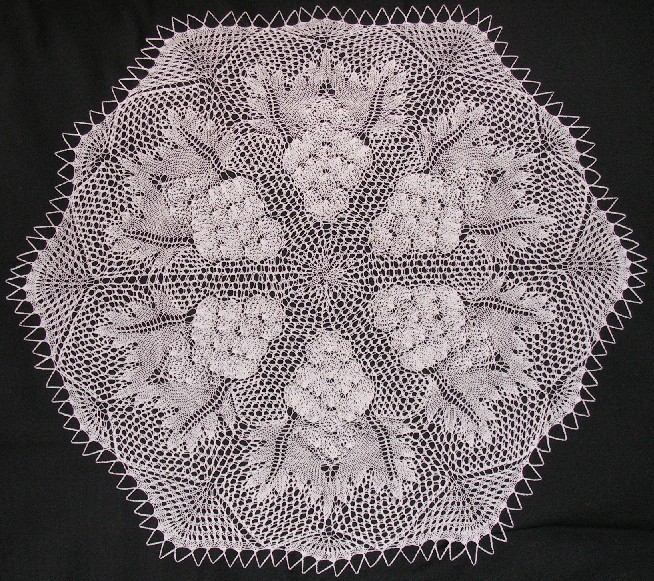
Burda 198/16: "Weintrauben" by Herbert Niebling

Fresh off the needles and crochet hook:


Blocking:


The finished result:


Pattern: Pattern #16, "Weintrauben," from Burda Special 198 ("Wine Grapes")
Thread: Cebelia 30 crochet cotton
Needles: 2 mm

This table center (it averages about 21 inches across, so I think it's a little big to be called a doily, yet it's not a tablecloth) was designed by Herbert Niebling, and he's given credit for the design in Burda 198. Sadly, doily designers don't always get credited in publications. Burda 554/5 and 554/6 were uncredited. Either the names of designers are really lost to history, or equally unfortunately, the publishers of doily patterns don't care about giving credit where credit is due when they could do so.

Some of Niebling's designs feature botanical motifs on a hexagonal mesh lace background. Not all of them, but these designs are the ones knitters tend to identify most with Niebling. (Well, the knitters who give a hoot about doilies, anwyay!) Burda 418/50, the nameless doily with the little oak leaves, was designed by Niebling too. Although the leaves are differently shaped, the lobes in the leaves in both 418/50 and Weintrauben are formed in the same way, using [yo, k1-p1 into the same stitch, yo] to make the spaces between the lobes, and [k2tog, k1, s1-k1-psso] followed by k3tog in the next pattern round to finish off each lobe tip.

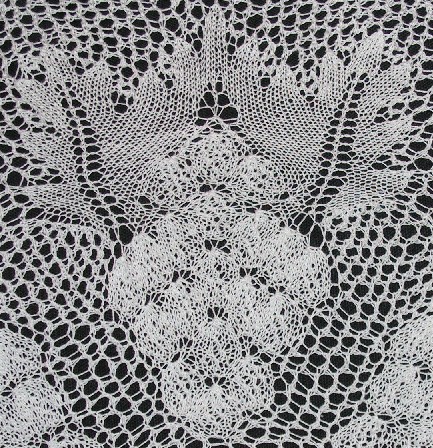
Weintrauben was a fascinating pattern to knit. It has six large sections, which means that the stitch repeat was huge. My eyes didn't wander from the chart too much—there was no blindly getting into a rhythm of repeating stitches here except in the final rounds of the border. The "grapes" are formed by an ingenious combination of many different types of stitches: make 1, k1tbl, k1-p1 into the same stitch, k6tog (which I executed as sl3-k3tog-psso), and 1x1 crossed stitches (which adds a bit of a 3-d texture to each grape!). On top of it all, the grapes are arranged in a staggered fashion through the "bunch"—each round you are working through different grapes at different stages. In the same round, you may be finishing off the top of one grape located in the center of bunch while working the middles of grapes located at the outside of the bunch.


The hexagonal mesh is not unique to Niebling patterns (see Engeln 17D). It's a basic lace "ground" pattern basically formed by a double yarn over, usually followed by k1-p1 into the double yo in the next round. However, I find knitting k1-k1tbl into the double yo much faster for me (I knit English-style, throwing the yarn with my right index finger). The overall holes are also smaller when k1-k1tbl is used instead of k1-p1, because the k1tbl twists a part of the double yo thread and pulls it in, while k1-p1 wraps itself over and under the double yo thread. I think hexagonal mesh using k1-p1 results in a more open and slightly neater appearance, which I also like, but there is a definite trade off for me in terms of additional time and effort.

I also decided on k1-k1tbl mesh for this pattern because when I examined the photograph in Burda 198 before casting on, it vaguely looked to me like the cloth was pulled a little too taut in the rounds near the top of the grape bunch. If it was in fact taut there, there may have been too few stitches for being that distance from the center. Since the center of the doily is all hex mesh and k1-k1tbl would make the mesh smaller overall, I thought I could maybe avoid any tightness around the top of the grape bunch by ensuring that the whole pattern of grapes would be closer to the center. So, I just made the decision to start knitting the pattern using k1-k1tbl.

Since I was never certain that the original sample was flawed, my cloth may have been fine with k1-p1 mesh after all. In fact, right after taking it off the needles, I was afraid that I had made a huge mistake by possibly overcorrecting the issue (which would have given me a loosely ruffled cloth). To my relief, it easily blocked out flat without any problems.

Coming soon

Even before I had cast on Weintrauben, I had knit up to the 90th round of this cloth, which will be even larger than Weintrauben:


That's a cone of 40/2 linen mounted for easy dispensing on a straight knitting needle in a modified shoe box.

Knowing too much about "doily math" can be a dangerous thing, since according to my calculations I am only 44% done. But other than the thought of having to work a lot of hexagonal mesh using k1-p1 this time, I am looking forward to finishing it. The pattern is not explicitly credited to Niebling, but I can definitely at least say it is in the same style. Huge leaves over mesh. More details when I am done.

Yes, the next big thing on my blog is going to be yet another table center/doily. I realize doilies don't get as much love in the online lace knitting world as shawls, but I'm trying to make up for some of that with my blog here.

29 October 2006

Burda 554/5


Pattern: Pattern #5 from Burda Special 554
Thread: 40/2 linen
Needles: 2 mm

This doily in linen thread blocked out more evenly than my Burda 554/6 doily, probably because it doesn't have large stockinette stitch sections or a lot of unusual textures.

25 October 2006

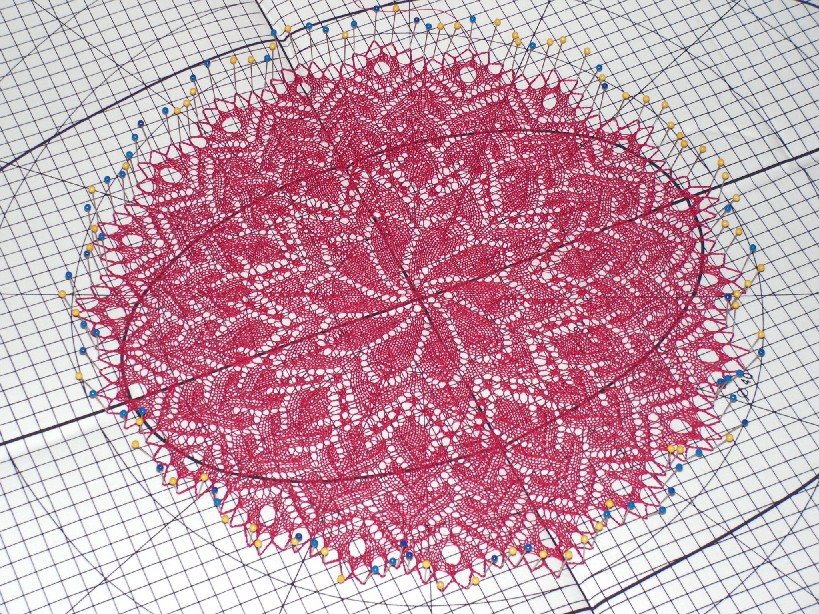
Egeblad

Pattern: Egeblad, available as a free pattern online (written instructions only, no charts)
Thread: Cebelia 30 crochet cotton
Needles: 2 mm

This pattern was originally designed by Christine Duchrow and is pattern #1 in her 64th leaflet (reprinted in The Knitted Lace Patterns of Christine Duchrow, Volume 3). It does not appear to have been named "Egeblad" by Duchrow.

I'm including a picture of it on the blocking foam. If you look very closely, you can see that I don't trim my thread tails until after I have finished blocking.

I knit the doily from the online pattern, not the original Duchrow charts. Despite the fact that I prefer using charts, the knitting was quick (I started and finished it within a single weekend, albeit an obviously lazy one!). It's a classic example of a doily that uses only single yarn overs and the basic decrease stitches (k2tog; sl1-k1-psso; and s1-k2tog-psso) to acheive a beautiful effect. There are no special increases, crossed stitches, tricky k5togs or k7togs, or a bunch of double yos to slow you down. The stitch repeats are small, and it's easy to stop looking at the pattern so much and just get into a rhythm (you end up with 20 repeats around the doily, so each repeat does not have too much going on even in the larger final rounds). I can definitely see why it's a popular lace knitting pattern in the online knitting world, and I would highly recommend it to knitters who are new to doilies.

Dark red Cebelia thread bleeds. A lot. I know red dyes usually bleed a bit during washing, but this thread turned my fingers red while I knit! I rinsed it five times before I was satisfied that not too much dye would continue to come out.

A word about the blocking foam in the picture: It's an item imported from Germany that is available from Lacis in California. I like that it has circles and ovals drawn in already—it seems designed for blocking doilies. But it's a flimsy lightweight foam. Since it has creases from being folded into quarters, I have to weigh it down at the corners during use just to keep it totally flat on the floor. And, a white doily on its white surface is practically invisible, making it harder than usual to block out. I much prefer the quality of this blocking board instead, which is heavy and very tough and...gray! It's actually made by a company that makes table pads for protecting dining tables, and no surprise, is quite similar to a table pad.

23 October 2006

Burda 554/6

Pattern: Pattern #6 from Burda Special 554
Thread: 40/2 linen, available here.
Needles: 2 mm

This pattern is full of interesting stitches beyond the basic left and right decreases and yarn overs. There are k3togs, k7togs, 1x1 crossed stitches, and one I haven't seen too often: slip 1, knit 2 (not k2tog!), pass slipped stitch over the 2 knit stitches (a 3-into-2 decrease).

I plan to post some closeups comparing the 40/2 linen thread with a smooth crochet cotton like DMC Cebelia soon. Even from this doily picture, you can see how this linen thread itself is uneven and how the stitches are imperfect, probably because of the thread's "crunchy" texture. In my experience with this and several other doilies, this 40/2 linen thread doesn't seem to pull into perfectly even stitches as readily as a smooth cotton thread does. However, I think the slightly wobbly-looking stockinette stitch sections are rather interesting and not necessarily a bad thing, depending on your taste; it's just different from the usual die-cut look with the high quality crochet cotton. I also love how the linen makes the blocked doily feel slightly rigid without any starch. It's a little like a piece of paper.

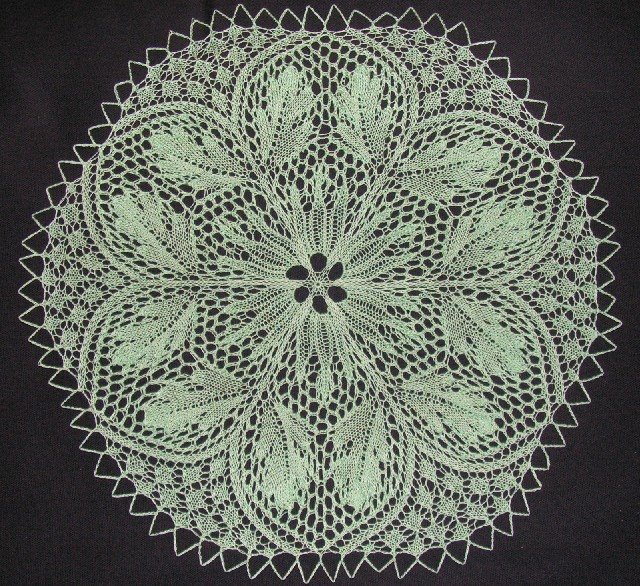
Doily by Erich Engeln


Pattern: "D" from Erich Engeln leaflet #17
Thread: Cebelia 30 crochet cotton
Needles: 2 mm

This pattern is available here. It's in German, but everything is well charted.

Also note that this doily and the one below are knitted in a light green shade of Cebelia. Do not adjust your monitor—they're not supposed to be white!

Doily by Herbert Niebling

Pattern: Pattern #50 from Burda Special 418
Thread: Cebelia 30 crochet cotton
Needles: 2 mm

This doily is credited to designer Herbert Niebling in Burda 418. Unfortunately, the Burda magazine is out of print, but this pattern is still available as a leaflet published by Coats Intermezzo.

In the original pattern, two of the six corners have double the number of small diamonds, resulting in a pointy oval or "eye" shaped doily. I knit all of the corners the same way.