Showing posts with label math. Show all posts

13 November 2006

Doily math, part 3

No, no, don't run away! This math stuff comes in handy, I swear!

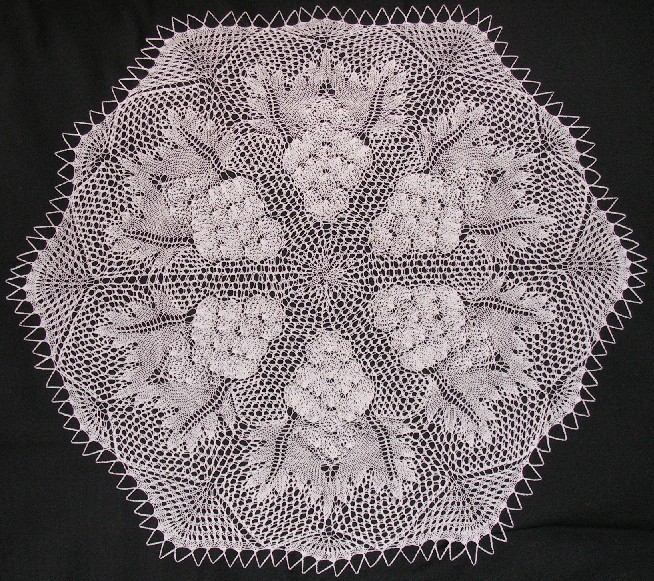
Laritza asked how much thread I used for Weintrauben. This pattern wasn't that big—it was 130 rounds. I used only one ball of Cebelia 30, which is about 560 yards per ball. I had a small amount left over, enough that I was never nervous about running out at the end, but I doubt I would tempt fate and start a 140-round pattern with only one ball on hand.

Now I have a personal benchmark for knitting with Cebelia 30. According to all that stuff that got worked out in Doily Math Part 1 and Part 2, it should take four times as much thread to knit a pattern with twice the number of rounds.


Whoa, whoa, slow down. Where did that come from?

Hmmm. There's a reason why I'm not a math teacher. Let me see if I can just boil it down to an easy-to-use general formula.

Let's say you know how many rounds you can knit with one ball of some thread before running out. (I strongly suggest subtracting say, 4 or 5 rounds from this number, just to give yourself some room for error and because you will need extra thread to crochet off the doily at the end.)

  • The estimated number of rounds you will be able to knit =

    √(number of balls you have * (the number of rounds you can knit with one ball)²)
In case the math symbols are hard to read: square the number of rounds you can knit with one ball, then multiply that result by the number of balls, then take the square root of the whole thing. That's how many rounds you can get out of the balls of thread you have.

Note that the above formula works with fractions of balls too (i.e., number of balls you have can equal .5 or 1.5 or whatever). If I can knit one 130-round pattern with one ball of Cebelia 30, according to the formula, I should be able to knit one 90-round doily out of half of one ball. (Since I'd never know if I have exactly half of a ball, what this really means is that I can get two 90-round doilies out of one new ball.)

Ok, I'm done with boring math stuff for now. Knit on!

24 October 2006

Math for doilies and shawls, part 2

Let's compare the estimates from part 1 to a stitch-by-stitch calculation of a simple hypothetical doily having 16 total rounds. This doily starts with 8 stitches in round 1, increases to 16 stitches in round 3, 24 stitches in round 5, and so on (8 stitches increased every other round, a "standard" increase rate that produces a flat doily). There are 64 stitches in each of final rounds 15 and 16.

The total number of stitches in this doily is (8+8+16+16+24+24+32+32+40+40+48+48+56+56+64+64) = 576

After round 8 of 16, the total number of stitches is (8+8+16+16+24+24+32+32) = 160

160 stitches/576 stitches = .277 (i.e., 28%) In other words, after round 8, about 28% of the stitches have been completed, which more or less corresponds to the "25%" quick estimate from above.

Also, 70% of the total number of rounds (16) is about 11 rounds. After round 11, there are 288 stitches. 288 stitches/576 stitches = .5 (i.e., 50%) In other words, half of the stitches have been knitted, just as predicted by the estimate from part 1.

Of course, increasing eight stitches every other round can produce a square or a circular shape depending on where the increases are placed in the pattern. As far as estimating the number of stitches left to knit, it doesn't matter what shape the pattern is, so long as it is basically flat.

What about triangular shawls, the kind knitted back and forth from a few stitches cast on at the center of the neck with rows getting longer and longer? Like the Kiri shawl by Polly at alltangledup or the Flower Basket shawl by Evelyn Clark? Well, they are essentially half of a square knitted from the center out, where 4 stitches increased every other round is a good rule of thumb for producing a flat triangular shape. The percentages are the same for a triangle as if you were working all the way around a square—when you have knitted half of the total number of rows, you have completed about 25% of the shawl, and when you have knitted 70% of the total number of rows, you have completed about 50% of the shawl (not counting any additional knitting like a sideways-knitted lace edging).

Math for doilies (and shawls) knitted in the round, part 1

Say your doily is 100 rounds. You have just finished round 50 and are "halfway" through the pattern, but of course you're not actually halfway through the knitting because the rounds so far have been relatively small and are only getting bigger and bigger. Question #1: Well, how much of the doily have you completed, then? Question #2: How many rounds will you have to finish before you're really at the halfway point?

For exact answers, you can count up all the stitches in the doily round by round (a spreadsheet would help!). You can then divide the number of total stitches by the number of stitches completed so far to find out how much of the knitting you've done. However, there is an easier way to estimate the answer instead, based on the fact that the area of a circle is equal to pi times the square of its radius. Think of comparing two circles—one circle is the finished, whole doily; the other circle is the doily in progress.

Note that we also have to assume that the doily is flat and increases more or less evenly and gradually (like eight stitches increased every other round—but the exact numbers are not critical). This math doesn't quite apply so well to an Elizabeth Zimmermann "Pi shawl," where there are many rounds with no stitch increases and a few rounds where the stitch count suddenly doubles. (I'll have to look into pi-shawl math some other time!)

Estimated answer to question #1:

  • The fraction of the finished doily you have so far is equal to about (the number of rounds completed so far)²/(the number of total rounds in the finished doily)².
Plugging in the numbers from our example: 50²/100² = 2500/10000 = .25 (i.e., 25%)

So, in a doily with 100 total rounds, you have knitted about one fourth of the doily when you have finished round 50.

Estimated answer to question #2:

  • The number of rounds completed before you get to a certain fraction of the finished doily is equal to about (the square root of fraction of the finished doily)*(the number of total rounds in the finished doily).

Plugging in the numbers from our example, √.5 * 100 rounds = .707 * 100 rounds = 70.7 rounds

For a doily with 100 total rounds, you have knitted about half when you have finished round 70 or 71.

Based on the results above, here are some easy to remember generalizations:

  • When you have knitted half of the total number of rounds, you have knitted about one fourth of the total doily.
  • You have knitted half of the total doily when you have knitted about 70% of the number of total rounds.

Other examples:

To estimate how many rounds it takes to complete 80% of a 125-round doily, use equation #2: √.8 * 125 rounds = 111.8 rounds.
Or, to estimate how far along you are when you have just finished round 85 in a 96-round doily, use equation #1: 85²/96² = .78 (i.e., 78%)

Remember that every pattern is different and these are just general estimates. However, if anything, the math demonstrates that you should not understimate the amount of time (and thread!) you still need when you may be "only" a dozen rounds from finishing a large doily.